Search This Blog

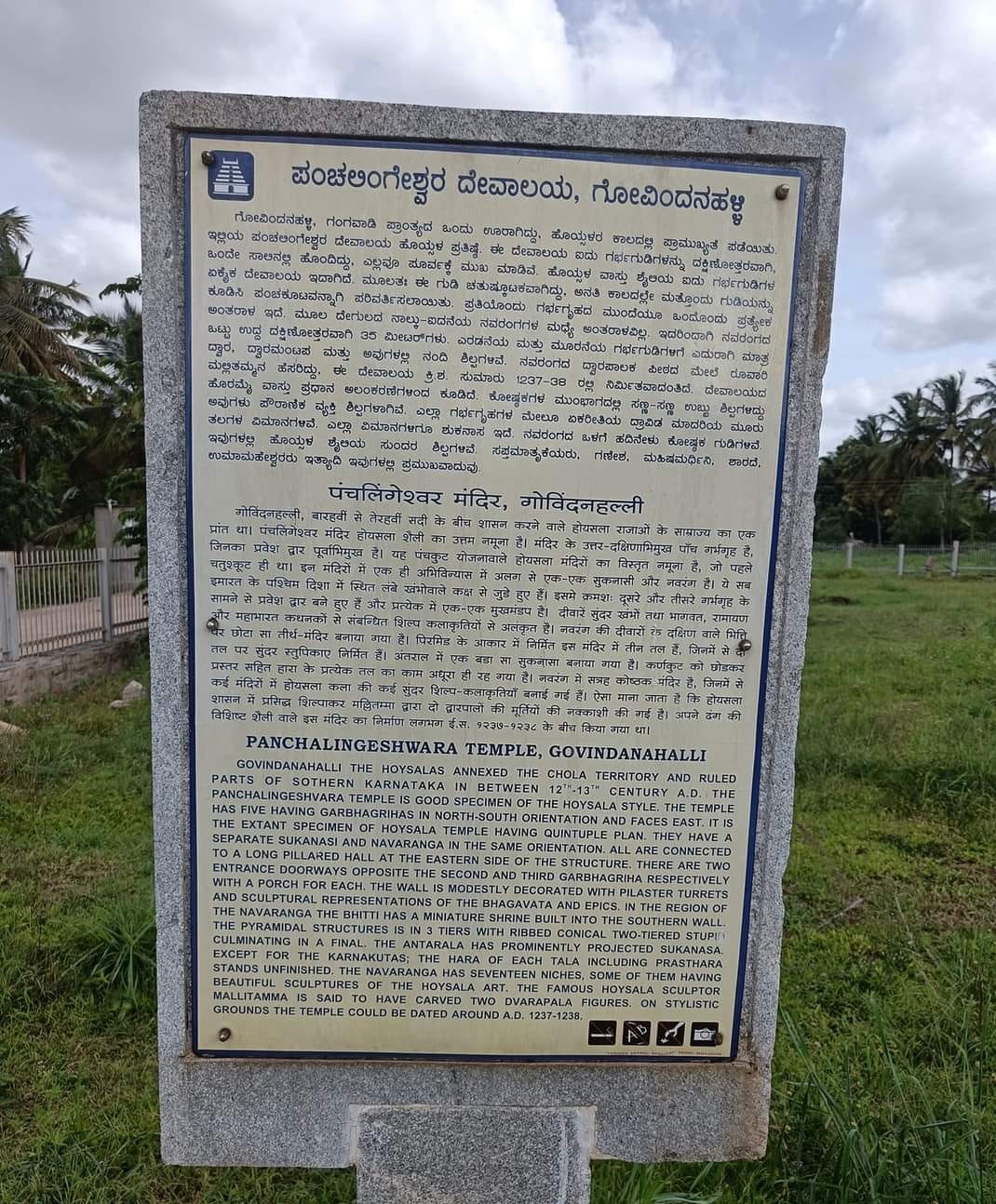
THE HOYSALA PANCHALINGESHWARA TEMPLE

PANCHALINGESHWARA TEMPLE - Govindanahalli - Mandya - Karnataka.

The term Kuta or shrine could be derived from the Sanskrit term Kuti, which means house.

This Hoysala temple started as a Chaturkuta (4) got extended as a Pancha (five) kuta (shrines) temple for lord Shiva showing the five aspects related to Sadashiva, namely Tatpurusha, Vamadeva, Aghora, Satjyotha & Ishana.

The Kutas or Shrines are lined up from north to south, with all the Garbhahriha's facing east having a Shiva Lingam each, with a beautifully decorated Nandi facing the lingam from the Navaranga(3 nandis) or outside (2 nandis).

Each Garbhahriha has a small Antarala or Ardhamandapa, which leads to a common Mukhamandapa or Navaranga.

The Navaranga seems to be like an elongated hall with four pillars in between for each shrine. Each Garbhahriha again has two small sub-shrines on both sides housing various gods like Vinayaka, Mahishasuramardini, Bhairava, Sukhasanamurthy, Kartikeya, etc.

This rectangular Navaranga can be entered by two north facing entrances, which houses 4 lathed  pillared Mandapam with a decorated Nandi each and two magnificent Dwarapalaka's guarding the entrances before the second and third shrines.

Unlike other Hoysala temples, this temple is devoid of a pedestal (generally star shaped) maybe because of its rectangular nature, however it has all three tiered Vimana's with exquisite carvings & lotus shaped Kumbhams made in stone.

The outer wall of the Garbhahriha's (Devakoshtha) from the lower edge of the vimana to the adhishthana seems like the canvas of the Hoysala sculptors,  filled with pillasters holding photo frames like shrines depicting gods and goddesses and frames from Hindu epics.

Inspite of this being a Shiva temple, these frames contain Mahavishnu from the Chaturvimsati murtayaha. It also contains idols and icons of Devakanya's, Vinayaka, Indra on Airavata, Parvati, Narasimha, Garuda, Brahma, Karthikeya, Nataraja, Ravaanugraha, Dancing Vaani,Parameshwari, Shiva and Parvati with mongoose,Varaha, Krishna.


Though inaugurated during the reign of the Hoysala King Veera Someshwara (1234-63) in 1238 CE, the temple seems to have been constructed over a period of time during the 13th century CE. The Sthapathya of the temple is also associated with one of the prominent Sthapathees Ruvari Mallithamma.
CHANDRAMOULESHWARA TEMPLE, UNKAL

The Chandramauleshwara Temple, sometimes referred to as the Candramauḷisvara or Chandramouleshwara temple at Unkal, is an 11th century Shiva temple with Chalukyan architecture in Unkal (Hubballi), Karnataka, India. 

The temple has a square plan architecture with four entrances from the cardinal directions, while illustrating the sandhara plan found in Sanskrit texts on architecture. It originally had a Chaturmukha (four-faced) Linga in the center of the temple and many more mandapas (halls), but the surviving structure is much smaller. The temple preserves an early example of a relatively uncommon Hindu architecture. The temple is also notable for how it integrates the artwork of Shaivism, Vaishnavism, Shaktism and Vedic deities together.

Chandramauleshwara temple at Unkal

Creator Bommanna Dandanayaka

Chandramouleshwar is a monument from the Kalyana Chalukyan era. It lacks a foundation inscription, and its date thus has to be indirectly inferred by other inscriptions that mention it, architectural style and iconographic details. According to Dakhy and Meister – scholars known for their encyclopaedia on India temple architecture and history, these factors suggest that "a date no later than the eighties of the 11th-century seems admissible".

The presence of two 12th-century stone inscriptions in Unkal village show that the temple was built in or before the 12th-century. The Archaeological Survey of India assigns it to the 12th-century.

Architecture

Chandramouleshwar Four-faced Shiva lingam, one of the face from side.

The temple is a remarkable building that illustrates the sandhara plan, with a square garbhagriha that can accessed from four cardinal directions. This open from all sides plan comes with four molded walls each with decorated doors. The doorjambs are decorated with pancha shakhas (five concentric band of fine carvings), but the artisans made each door unique. The eastern door is particularly excellent, one of the best from the 11th-century. Each door has a pair of dwarapalas. The temple includes a pradakshina patha for circumambulation. It also has an antarala and a sarvatobhadra-style mukhamandapa.

The outer walls include the architectural and decorative details in major Hindu temples, but to accommodate the four entrances, the temple integrates ardha-mandapas that function as antaralas. The original temple had mukhamandapas on the north and south side for the pilgrims to gather, but that is now lost and only mutilated and damaged sections of these sections can now be traced. The details in and above the mancabandha adhistana are elegant, with a band of flowers, then alternating horse-elephant rajasena, above which is the vedikas with miniature but beautiful musicians, then gandharas framed between aedicules, topped with wood/jewel-like detail kaksasana carvings.

The jalas in this temple are of two types – gulika and puspakantha – both elegantly completed, with timber-like finish.

The jalas in this temple are of two types – gulika and puspakantha – both elegantly completed, with timber-like finish.

Originally, the temple housed the image of Chaturmukha linga at the very center so that the pilgrim could see one face of Shiva no matter where she or he stood. However, at some point, this was moved and it is now in the western side of the temple. One possible explanation was offered by Henry Cousens after his survey of this site. The temple likely suffered destruction after the 13th-century, went into disuse. The "very dilapidated" temple was later appropriated by Lingayats who moved the Chaturmukha linga and replaced it with a plain linga they preferred.

The outer walls of the temple have niches framed with pilasters. These depict a galaxy of deities and Hindu legends from all the major traditions within Hinduism: Brahma, avatars of Vishnu, and various forms of Siva. Of particular note are the Nataraja, Narasimha, dancing Ganesha, Sarasvati and Mahishasurmardini. Another notable feature here is that two of the four lalitabimbas into the sanctum have Gajalakshmi and two have Sarasvati, a fact that led Cousens to suggest that this temple may be much older than the 11th century and might once have been a Brahma temple.

Sri Gokarna Mahabaleshwara Swamy Temple

Gokarna Sri Mahabaleshwara Temple is a 4th-century temple situated in Gokarna, Uttara Kannada District, Karnataka. Srikshetra Gokarna is one of the holiest places in India. The Father of the universe Parashiva is in Gokarna in the form of Athmalinga. The temple faces the coast of the city of Karwar from the Arabian Sea of the Western Sea. The Almighty, known as Mahabaleshwara, is also known as Sarvabhouma.

The Mahabaleshwar temple is considered as sacred as the Shiva temple on the banks of the Ganges in Varanasi and Kashi in North India. Hence, Gokarna is known as Dakshin Kasi. This is the place where the most revered Hindu saint Adi Shankaracharya, who spread spiritual knowledge from south to north throughout India, established Shree Ramachandrapura Math, sacred and saintly Jagadguru Peetam.

The temple is run under the guidance of Paramapoojya Jagadguru Shankaracharya Gokarna Mandaladheeshwara Shree Shree Raghaveshwara Bharathi Mahaswamiji of Sriramachandrapur Math. Under the divine and philanthropic guidance of Sri Mahaswamiji, the administration of Sri Mahabaleshwara Temple, Gokarna is on the path of progress.

Gokarna Mahabaleswara Temple History:

In order to obtain the Athmalinga of Lord Shiva, Ravana performed severe penance at Kailasa and secured the Athmalinga. The Suras frightened by this approached Lord Ganesha and prayed to Him, to retain the Athmalinga at Gokarna. As the abode of the one and only one Athmalinga of Lord Shiva, Gokarna gained worldwide spiritual significance. This holy place is known as Bhookailasa and the Southern Varanasi. (Ref. Skandha Purana, Guru charitra)  In this Temple all devotees can enter the sanctum sanctorum and have the touch darshan of Athmalinga and can perform Abhisheka with their own hands. Shivaratri Mahotsava is the Car festival when lakhs of people attend and pray for their well-being. Nature :

This sacred Temple is situated on the Seashore and by the side of western ghats. Here we can hear the roaring sound of the sea and can see the jumping tides of the sea. At the same time, we can see the green scenario of the western ghat and can hear the melodious music of the winds.

Gokarna Sri Mahabaleswara Temple Pooja:

Every day thrice, Pooja is performed with Pancha Vadya. Morning Udyanabali, Afternoon bali, Mahapooja, evening Bali, Utsava and Mahapooja

Gokarna Shiva Temple Bhojana:

Free Amrutanna Prasad Bhojana is being served twice daily to all the devotees.

Afternoon 12.00 to 2.00 and Evening 7.30 to 8.30

Sri Annapoorneshwari Temple Mulladka

Annapoorna (Anna means food, Poorna means complete or filled with) Annapoorna is considered the goddess of food. Most people take the food with the literal meaning and think that Annapoorna is the goddess who nourished the world. There is no doubt about the same, but in the meantime, Sages like Adishankara have considered Lordess. Annapoorna is the one who nourishes the hunger of knowledge. She is also considered the complete form of knowledge.

According to legend, Annapoorna is the incarnation of Parvathi. The world is made of Prakruti (female form or motherly form divinity represented by Parvathi) and Purush (Male form of deity represented by Shiva). Once there was an argument between Shiva and Parvathi as to who was superior. Shiva comments that Parvathi is the form of Maya (Illusion) who takes the people away from knowledge, and Purush is more superior who takes them towards the knowledge.

Parvathi is enraged by this and leaves Kailash and goes and resides in Kashi. The disappearance of Parvathi leads to the great famine, and the Ganas of Shiva become weak due to hunger. They ask Shiva to feed them. Shiva searched for food but could not find food in any part of the world.

When Shiva reaches Kashi, he sees people flocking toward a kitchen for food. Shiva comes to the place with a begging bowl, and he is surprised to find a divine lady with a bowl of food in one hand and a serving spoon in another hand serving food to people. He realises that it is none other than Parvathi in the form of Annapoorna. She serves food to Shiva and makes him realise Purush is incomplete without Prakriti. (Prakrathi is also the form of knowledge that takes the Purush towards self-realisation)

According to another legend, once Brahma and Shiva had a heated argument, and in rage, Shiva cut one head of Brahma (Brahma initially had five heads). The beheaded skull of Brahma sticks to the hand of Shiva and curses him that until the skull is filled with grains, it will not get detached. Shiva asks for help from Vishnu. He suggests Shiva beg using the skull as a begging bowl, and when he is cleared of the sin of cutting the head of Brahma, it will detach. whereas Shiva went begging every were, but despite adding huge grain, the skull was not getting filled. In the end, Shiva reaches Kashi, where Parvathi( in the form of Annapoorna ) fills the skull with grains, the skull of Brahma gets detached, and  Shiva is cleared of the sin.

It is said that this is the oldest abode of Annapoorna in Undivided South Canara. It is said to be more than  800 years old. But unfortunately, it was in a dilapidated state and was forgotten. In 1975 the local devotees joined hands and built a humble sanctum.

The temple is a humble structure but exudes positive energy. If you travel by these roads do visit.

SRI ADI SHANKARACHARYA - SRI SHARADA LAKSHMINARASIMHA NAMAHA

Sreemath, Hariharapura, Koppa Taluk, Chickmagalur Dist., Karnataka, India.

Hariharapura, the holy land, located on the banks of River Tunga is where the Lord Daksha Prajapathi performed his great Yajna (Sacrifice), according to Skanda Purana (Sahyadri Kaanda). Lord Parama Shiva appeared from the ‘Yajna Kunda’ as Dakshahara Someshwara and blessed all. There is a ‘Swayambhoo Someshwara Temple’ here and hence it is considered as Yaga Bhoomi and sacred, auspicious and effective for performing homa, havana and yajnas.

This “Yaga Bhoomi’ became a ‘Tapo Bhoomi’ later, when Sage Agasthya stayed here and did penance (Tapas). The Lakshminarasimha Saligrama, worshipped by Sage Agasthya is in the main shrine at Hariharapura even today.

Later, this holy land of sacrifice and tapas turned into a land of wisdom/knowledge (Jnana Bhoomi) when Jagadguru Adi Shankaracharya installed Sri Chakra Yantra and consecrated the idol of Sharada Paramesheari, the Goddess of knowledge and gave ‘mantra diksha’ to Sri Sri Swayamprakasha Krishna Yogendra Saraswathi Mahaswamiji, the first Guru of this Peetam.

This yaga, Tapo and Jnana bhoomi having closeness to Lord Shiva was earlier known as ‘Kapaalam’. About 600 years ago, the Emperor of Vijayanagar Empire, Harihara Raya constructed an Agrahara here and gifted several villages to the Peetadhipathi Sri Sri Ramachandra Saraswathi Mahaswamiji. Hence this place came to be known as Hariharapura. So far 25 Gurus have adorned this Peetam and have been upholding, protecting and propagating (Dharma Samrakshana, Paripaalana and Prachara) the ancient ‘Sanathana Hindu Dharma’ in spite of many adverse situations, ups and downs in the country, socially, politically and spiritually with the strength of ‘tapas’ of the successive Gurus.

Veerabhadreshwara Temple -Kallathgiri falls

Being an unusual construction, not much is known about the history and inception of the Veerabhadreshwara Temple except for the confirmed fact that it was established during the reign of the Vijayanagara period. It is believed that the cave shrine was built during the reign of Krishna Deva Raya, the sixth ruler of the Sangama Dynasty in the Vijayanagara Empire.

Veerabhadreshwara Temple is dedicated to an avatar of Lord Shiva- Veerabhadra. According to mythology, Veerabhadra was created from the wrath of Lord Rudra after his wife Goddess Sati self-immolated herself during the great Yagna in the palace of her father King Daksha.


In tune with the location of most of the temples of Lord Shiva and his avatars, the Veerabhadreshwara Temple also stands on a pristine landscape near Kalhattipura, around 20 km south of Tarikere town in the Chikmagalur and about 10 km from Kemmannagundi. The temple stands quaint and mystic against the backdrop of the gorgeous Kalhatti Falls.

The metallic idols of Lord Veerabhadreshwara and Goddess Bhadrakali rest inside an ancient cave carved out between gigantic rocks. The entrance of this ancient temple is skirted with interesting stone carvings of three elephants. The sculptures of the deities as well as the indigenous art displayed on the rock carvings are a must see.

One must cross a small and shallow pool of water from the Kalhatti Falls to reach the temple. The raw and untampered nature of the temple, untouched by the artistic and scientific hands of men, lends the Veerabhadreshwara Temple a cabalistic and spiritual appeal. Devotees throng this temple seeking wealth, knowledge, salvation, and relief from chronic ailments.

CHAMPAKADHAMA SWAMY TEMPLE

The Champakadhama Temple is located in a distance of 20 km from Bangalore in Bannerghatta. This historical Champakadhama temple at Bannerghatta is dedicated to Lord Champakadhama incarnation of Lord Vishnu. The temple attracts huge number of devotees from Bangalore city and surroundings.

The Temple is maintained by Government of Karnataka. It houses unique stone scriptures. Champakadhama is another name of Lord Rama or Vishnu.

The history of the temple dates back to 12th century. As per the inscriptions found here, it is believed that the Champakadhama Temple was built in 1257 during Hoysala period under the ruler Tamilarasa. You can also see the writing which belongs to the 12th century as soon as you enter the temple premises.


The shrine houses idol of Lord Champakadhama along with Goddess Lakshmi and Goddess Bhoodevi. You can also visit temples dedicated to Lord Narasimha and Lord Sampangi on a hillock located behind the Champakadhama temple.

Ananthasayana Temple 

Ananthasayanagudi in Hosapet Bellary district, Karnataka state, India was constructed by King Krishnadeva Raya (1524 AD) of the Vijayanagara Empire in memory of his deceased son.

This North facing temple is one of the great monuments of Vijayanagara period. Built by Krishnadeva Raya, this temple is situated in Ananthasayanagu Di village, just outside of Hospete, Karnataka. The village itself was built by Krishnadeva Raya as Sale Tirumala Maharayapura in memory of his Son. Later it got the present name after this huge temple. The main deity of the temple was Anantha Padmanabha Swamy. Currently there is no Murthi in the Garbha Griha.


The Garbha Griha is a wide chamber measuring more than 20 meters in width, 6 meters in depth and about 20 meters in height. Yes, it is an unusual size for regular Hindu temples. The base of the statue suggests that the deity might have been in a reclined posture. There are three entrances to the Garbha Griha.

Visitors entering Garbha Griha will be awe struck by its huge proportions. There is every possibility for Hampi visitor to miss this temple as it is away from the main heritage sites of Hampi. Do make it a point to keep this in your Hampi itinerary.

Hombuja Atishaya Jain Teerth Kshetra

Humcha/Hombuja is a small village near Ripponpet, Hosanagara taluk in Shimoga district in the Indian state of Karnataka. Hombuja Atishaya Jain Teerth Kshetra is famous for being home to an ancient temple of Goddess Padmavati, and to the Humbaj Matha (seminary/monastery), an important institution of the Jain community. This temple is considered to be very holy and is known for its cultural and historical heritage.

Other notable highlights of the place are a lake that reputedly never dries up and a tree that likewise always remains green.

The History of this region is also associated with Santara or Bhairarasa dynasty. Santara or Bhairarasa is the name of a medieval ruling dynasty of Karnataka, India.

Jinadatta Raya, a Jain prince from Mathura in Northern India was the supposed founder of the dynasty. He is said to have migrated to the town of Humcha with an idol of the Jain deity Padmavati, laying the foundation of the kingdom in Humcha. The area covered by their kingdom included territories in the Malenadu region as well as the coastal districts of Karnataka. The dynasty founded by Jinadatta appears to have split into two branches by the 12 century C.E. One branch being stationed in Hosagunda of Shimoga district and Kalasa in the Western ghats, chikkamagalur district. Gradually these branches (or only the Kalasa branch) shifted their capitals to Keravashe (14 km north-east of Karkala) and Karkala both in the old South Canara district. Hence the territory they ruled was also known as the Kalasa-Karkala kingdom.

SRI SUBRAHMANYA SWAMY TEMPLE HALASURU

This popular temple dedicated to Sri Subrahmanya is more than 800 years old.

The temple is close to the celebrated Halasuru Someshwara Temple, and right opposite to Sri Adhi Vinayaka Temple near Halasuru metro station. It is said that this temple is older than Sri Someshwara Temple. The deity is also known as Ananda Murugan here. The lord Subrahmanya here is a replica of Murugan at Thiruthani Murugan Temple one of Arupadaiveedus of Murugan. Lord Subrahmanya is flanked by Valli on His right and Devasena on His left in this temple in separate shrines.

Legend has it that this temple was built by one of the Maharajas of Mysore many centuries ago.

The then Maharaja of Mysore was on his way to visit his uncle who was suffering from eye disease. It came to his notice that there were devotees frequenting an Anthill at the present site of the temple. The Maharaja visited the anthill and prayed that if his uncle is cured of the eye disease, he would build a temple at the site for the Lord. Once the Maharaja reached Mysore, it was brought to his notice that his uncle was cured of the eye disease. The temple was constructed to thank the Lord as a votive offering.

There is a sculpture of sage Mandavya in the Mantapam. As per one of the versions, Sage Mandavya had this temple built on being directed by the Lord. Some are of the opinion that this temple was built around the same time Sri Someshwara temple was built due to its connection with Sage Mandavya.

There are separate shrines for Chandikeshwara and Nagadevata. It is believed that the temple was once a Shiva temple. The temple also has Ardha Nareeshwara, Durga, Surya Narayana Sage Agastya, Navagrahas and Kalabhairava enshrined. The temple follows Shaivagama guidelines. There are Nandis on the temple walls and Lord Vishnu shrine at the back entrance of the temple. This is typical of a Shiva temple. The Sthala Vriksha is Athi maram. There is a tank within the temple premises.

Shivaratri Amavasya

Shivratri, or Mahashivratri, is the most auspicious day dedicated to Lord Shiva and is popularly known as the night of Siva. In Panchangs and Hindu calendars followed in Australia, United States, United Kingdom (Britain) and Canada. This holy night of Shiva is observed on the night before ‘amavasya’ in the Hindu month of Phalgun (February – March) as per traditional Hindu calendar followed in North India. The corresponding period in other regions is the night before Magh Amavasya.

Planetary Position on Shivaratri Night

It is believed that the planetary positions align in such a way on Shivratri night that it naturally creates an upsurge of energy in the human system. This is also why traditionally it is known to be beneficial both physically and spiritually to stay awake and aware through the night.

Shivratri and Amavasya (No Moon)

The significance of Shivratri is closely associated with ‘amavas’ - the no moon night or full dark night as per traditional Hindu Calendar. Amavas symbolically represents Kaliyuga or spiritual ignorance. Lord Shiva appeared just before the beginning of Kaliyuga to rid the world of evil and ignorance. Therefore Shivratri is celebrated to get rid of evil and ignorance.

It must be noted here that Shivratri is observed during Phalgun month in North India. The corresponding month in Gujarat, Maharashtra, Karnataka and Andhra Pradesh is Magh Month.

There is also a Masa Shivratri which is observed on thirteenth day of Krishna Paksha (waning phase of the moon) in all traditional Hindu months.